When we think about men’s health, we tend to picture men being active, sporty, strong and, well, manly. We think about physical fitness, heart health, prostate checks and increasingly mental health, which quite rightly has been given a much bigger voice in recent years.
But I do wonder whether we’re missing something in between.
What about the everyday aspects of wellbeing? The aches and pains that gradually become the norm, the tension we carry in our shoulders, the poor night’s sleep, or simply taking an hour out to do something good for ourselves?
Women have perhaps been more comfortable with the idea of self-care for years. Booking a massage, having a treatment or taking a little time out isn’t necessarily seen as an indulgence. It’s just something we do occasionally to look after ourselves.
For men, I think it’s often quite different.
There’s still a tendency to carry on, push through discomfort and only seek help when something becomes sufficiently painful or troublesome that it can no longer be ignored.
But why should we wait until something goes wrong before we start looking after ourselves?
A change I’m beginning to notice
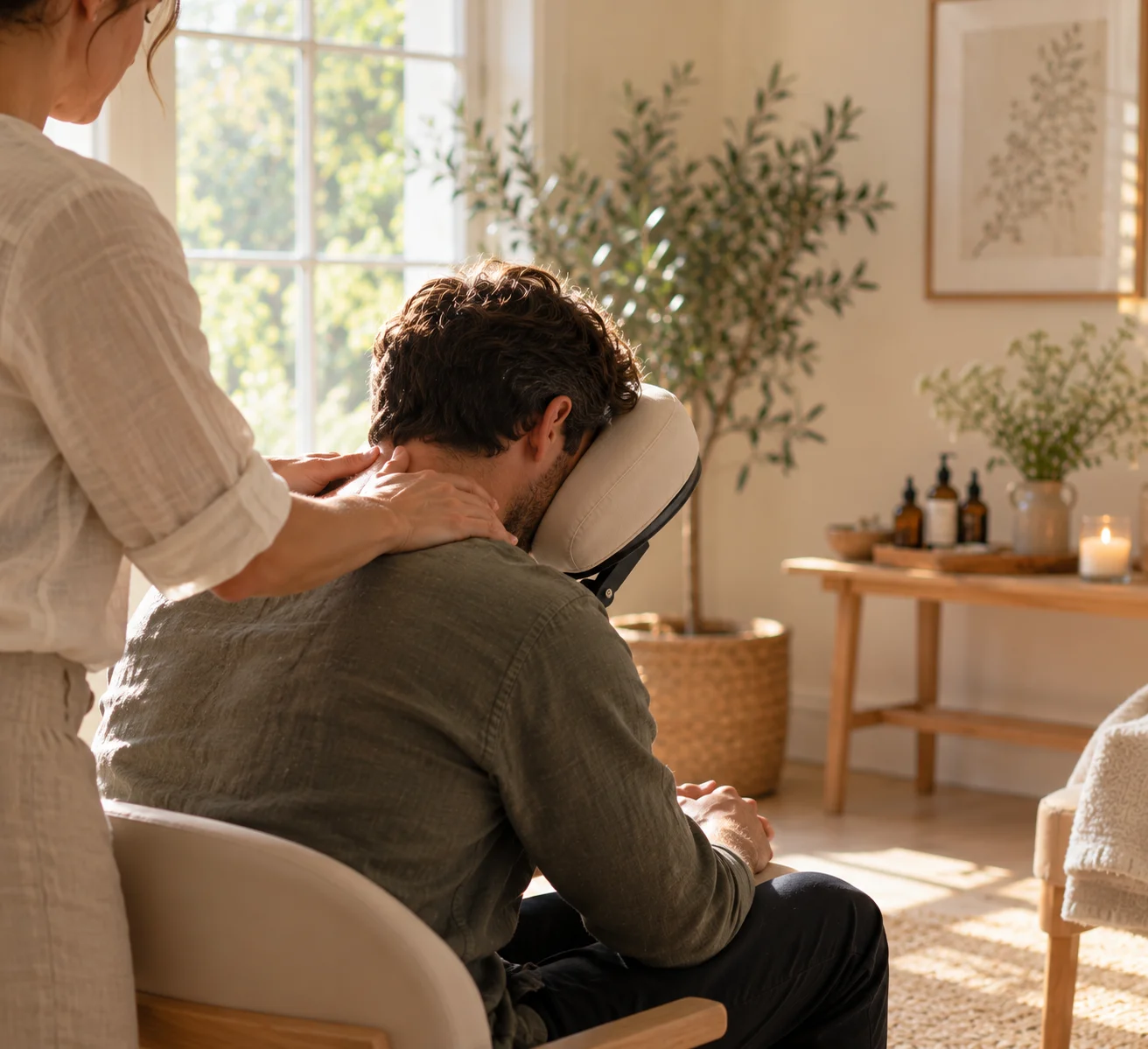
Something I’ve found particularly interesting in my own practice is that I’m seeing more men booking Indian Head Massage.
And there’s a rather practical reason behind some of these bookings.
Many employers now offer staff a wellbeing allowance, sometimes around £50, which can be used towards complementary therapies and treatments.
What a great initiative.
For some men, this seems to provide the perfect opportunity, or perhaps even the excuse, to try something they might never have considered paying for themselves.
And I think that’s rather telling.
Perhaps we’re beginning to recognise that wellbeing isn’t just about going to the gym, eating healthily or dealing with a problem when it arises. It’s also about giving our bodies a little attention along the way.
Restore: when those niggles become something more
One of the main therapies I offer at Elmara Vitality is low-level laser therapy, also known as photobiomodulation.
Now, I’m not suggesting someone needs to book a course of laser therapy every time they wake up with a stiff shoulder or a minor ache.
But what about that troublesome elbow that’s been bothering you for months? The shoulder injury that never quite recovered? The persistent pain that you’ve learnt to live with, reaching for the painkillers whenever it flares up?
Or perhaps an injury that seems to be taking far longer to recover than you expected.
These are the sorts of problems that can gradually affect how we move, sleep, work and enjoy life.
Therapeutic laser therapy uses specific wavelengths of light to interact with cells and influence biological processes involved in tissue repair, inflammation and pain.
There’s a growing body of research into photobiomodulation for certain musculoskeletal conditions, particularly in helping to manage pain and improve function. It isn’t the answer for every injury or long-term condition, but for appropriately assessed problems it can be a valuable, non-invasive option.
What I find particularly interesting about laser therapy is that it isn’t simply about providing temporary pain relief. It works with the body’s natural biological processes to support tissue repair and recovery, with the aim of achieving longer-lasting improvements rather than simply masking the symptoms.
And this leads me to another question.
Why do some injuries or areas of discomfort seem to take so long to recover?
Of course, there are many possible reasons. The nature of the injury, age, underlying health conditions, circulation, repeated strain and whether the original problem has been properly addressed all play a part.
But we also need to consider what’s happening in the rest of the body.
Are we getting enough quality sleep? Are we eating well enough to provide the nutrients needed for repair? Are we allowing ourselves adequate recovery time, or are we constantly pushing through discomfort?
This is where I believe looking at the whole person becomes so important.
Laser therapy may be one part of the recovery process, but the way we nourish and look after ourselves can influence how well our bodies recover too.
Restore: sometimes it’s simply about feeling good
Not every ache or bit of muscular stiffness needs laser therapy.
Sometimes what we really need is to loosen tight muscles, release tension or simply enjoy an hour where nobody is asking anything of us.
That’s where massage can play such a lovely role.
Indian Head Massage is one of my favourite therapies to offer, partly because people are often surprised by just how relaxing it can be. It’s not just about massaging the scalp. My sessions include the upper back, shoulders, neck, head and face, areas where we often hold an enormous amount of tension without even realising it.
And the face is particularly interesting. Our faces are incredibly sensitive, with a rich supply of sensory nerve endings, yet how often do we actually receive a gentle, relaxing facial massage?
We wash our faces, shave, apply creams and go about our day, but rarely give those muscles and sensitive areas any real attention.
Gentle massage around the temples, forehead, jaw and face can feel wonderfully soothing, particularly when combined with work on the scalp, neck and shoulders.
For some people, the opportunity to completely switch off is reason enough to book a session.
And why shouldn’t it be?
"We service our cars, maintain our homes and replace things when they stop working properly, yet we can be remarkably reluctant to invest a little time in maintaining ourselves."
Nourish: giving the body what it needs
We can’t expect our bodies to function at their best if we’re constantly running on empty.
Nutrition, sleep, hydration and lifestyle all influence our health, energy and ability to recover.
Having studied food and nutrition alongside my therapeutic qualifications, I’m particularly interested in how these different aspects of wellbeing connect.
Protein, for example, is essential for maintaining and repairing tissues, while a varied diet rich in vegetables, fruit, healthy fats and other nutrient-dense foods helps provide the building blocks our bodies need.
Sleep is another huge consideration. It’s during sleep that many important restorative processes take place, yet how many of us consistently get enough?
And then there’s stress, alcohol, physical activity and the simple question of whether we’re allowing our bodies enough time to recover.
None of these things works in isolation.
It’s all very well working on a painful shoulder, but if someone is sleeping badly, eating poorly and repeatedly aggravating the same injury, we may be overlooking factors that are affecting their recovery.
That doesn’t mean lifestyle is responsible for every slow-to-recover injury, but it certainly deserves a place in the conversation.
Thrive: looking after ourselves before we have to
For me, thriving isn’t about being super-fit, following the perfect diet or trying to turn back the clock. It’s about being able to do the things we enjoy, comfortably and for as long as possible.
Whether that’s playing golf, cycling, gardening, walking the dog, working without persistent discomfort or simply having the energy to enjoy life outside work.
And perhaps it’s about changing the way we think about looking after ourselves.
We service our cars, maintain our homes and replace things when they stop working properly, yet we can be remarkably reluctant to invest a little time in maintaining ourselves.
Especially when we think we should just be able to get on with it.
At Elmara Vitality, my philosophy is Restore. Nourish. Thrive.
- Restore by addressing physical discomfort, supporting recovery and allowing time for relaxation.
- Nourish through nutrition, sleep and everyday choices that support the body.
- Thrive by maintaining our mobility, independence, energy and enjoyment of life.
Through therapeutic laser therapy, Indian Head Massage, seated massage and a wider interest in nutrition and wellbeing, I aim to help people look beyond the immediate symptom and consider the bigger picture.
Welvow includes massage therapists, laser therapists, sports therapists and others who work with everyday aches, recovery and relaxation, including Emma Seddon. Most offer a short introductory call, which is the easiest way to ask how they work before committing to anything.
Find your practitionerBecause men’s health shouldn’t simply be about waiting until something hurts enough to do something about it. It’s about recognising that looking after ourselves is worthwhile at any age. And if a £50 workplace wellbeing voucher is what first encourages a man to experience an Indian Head Massage, then I think that’s a pretty good start.