Around one in seven couples in the UK has difficulty conceiving, and roughly a third of the time no clear cause is found on either side. That last part is the bit people struggle with most. When there is nothing obvious to point at, it can feel as though there is nothing useful to do.
I teach yin yoga, so I look at bodies for a living: how they sit, how they stand, how they hold themselves when nobody is watching. And one thing I notice, again and again, is how rarely posture comes up in any conversation about fertility. Not as a cause, and not as a culprit. Simply as part of the picture of how a body is functioning, in the same way that sleep and food and stress are part of it.
What I see in the room
Bodies today are shaped by the things they do most. Long hours at a desk, long hours on a phone, and comparatively little time moving through a full range. The result is familiar enough that it barely registers as unusual any more: shoulders rolled forward, a ribcage that has drifted out of line with the pelvis, hips that have been folded into the same angle for hours a day.
What used to be described as an older body's posture now turns up in people in their twenties. That does not mean anything is wrong. It does mean the body is spending most of its time compressed rather than open, and compression has consequences for how easily things move through us: blood, breath, lymph, all of it.
Why space matters
The abdomen and pelvis are a crowded neighbourhood. The reproductive organs sit alongside the bladder, the bowel and a dense web of blood vessels, all of it wrapped and separated by fascia, the connective tissue that gives the body its internal shape.
Fascia responds to how we use ourselves. Held in one position for long enough, it becomes less mobile, and the tissues it wraps have a little less room to move. Nobody is claiming this is what stands between a person and a pregnancy. But circulation to any part of the body is easier when there is space around it, and creating space is one of the few things a person can genuinely do something about.
Breathing sits underneath all of it
The diaphragm is the muscle that does most of the work of breathing, and it also sits directly above the abdominal organs. Each full breath moves it downwards, which gently shifts everything below it. Breathe shallowly into the upper chest all day, as many of us do when we are braced or hurrying, and that internal massage largely stops happening.
Slower breathing lower into the ribs and belly is also one of the more reliable ways to bring the nervous system down a notch. For anyone in the middle of trying to conceive, where the mental load is often relentless, that in itself may be worth having.
"Compression is not a verdict on anything. It is simply a description of what a body is doing, and unlike much of this it is something you can start to change today."
Where yin yoga comes in
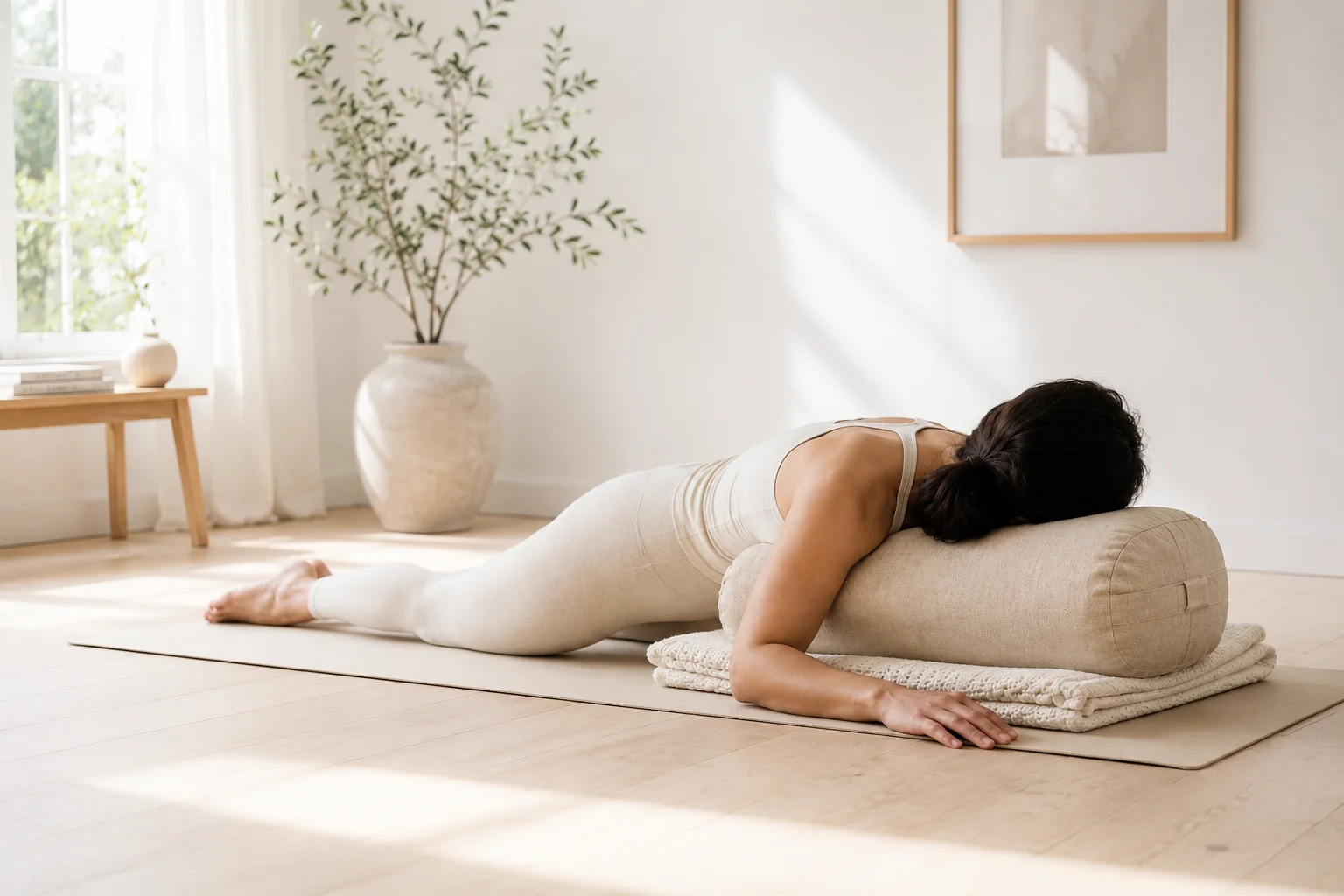
Yin is a quiet practice. Shapes are held for two to five minutes, mostly seated or lying down, with the muscles deliberately soft so that the load falls on connective tissue instead. There is very little to achieve and nothing to keep up with, which is part of why people who find other forms of exercise draining often get on with it.
Most yin sequences spend a lot of their time around the hips, the groin and the lower back. In traditional Chinese medicine those areas carry the meridians associated with the reproductive system, which is why yin and fertility often get mentioned in the same breath. Whether or not that framework speaks to you, the physical effect is straightforward enough: time spent opening the hips and lengthening the lower back is time not spent folded into a chair.
What people tend to report afterwards is not dramatic. They stand a little taller. They breathe further down. They notice tension they had stopped noticing. Over weeks, that adds up to a body that spends more of its day with room in it.
A gentle place to start
None of this needs to become a project. A few things worth trying:
- Set something to remind you to stand and move every hour or so, rather than relying on noticing.
- Once a day, lie on your back with your knees bent and spend two minutes breathing so that the belly rises before the chest does.
- Add one or two long-held hip shapes in the evening. A supported butterfly or a reclined figure-four is plenty.
- Notice how you carry your ribcage when you walk. Most of us are either braced up or collapsed down; somewhere in between is the aim.
If you are already under the care of a fertility team, none of this replaces any of that. It sits alongside it, as one of the small everyday things that is entirely yours to decide about.
If this way of looking at the body interests you, Welvow includes yin yoga teachers, yoga therapists and practitioners working with fertility support who can help you find a version of this that suits your body and your circumstances. Many offer a free introductory call and online sessions, so you can start gently, from home.
Find your practitionerThe body responds to how it is used, over and over, in small ways. That is not a promise about outcomes. It is simply how bodies work. In a process where so much sits outside anyone's control, spending ten minutes creating a bit more space and breathing a bit lower is a reasonable, kind thing to do for yourself.