If you have ever searched for hypopressives, you have probably come away more confused than you started. Long words, unusual breathing, and vague promises about your core and pelvic floor. So let me strip it right back.
I am a biomechanics coach, which means my whole job is understanding how a body moves, holds itself, and shares load between joints and muscles. When I put that lens alongside hypopressive training, something genuinely useful happens, and I want to explain why, without the jargon.
What hypopressives actually are
Hypopressive comes from hypo, meaning low, and pressure. So the name just means low-pressure technique.
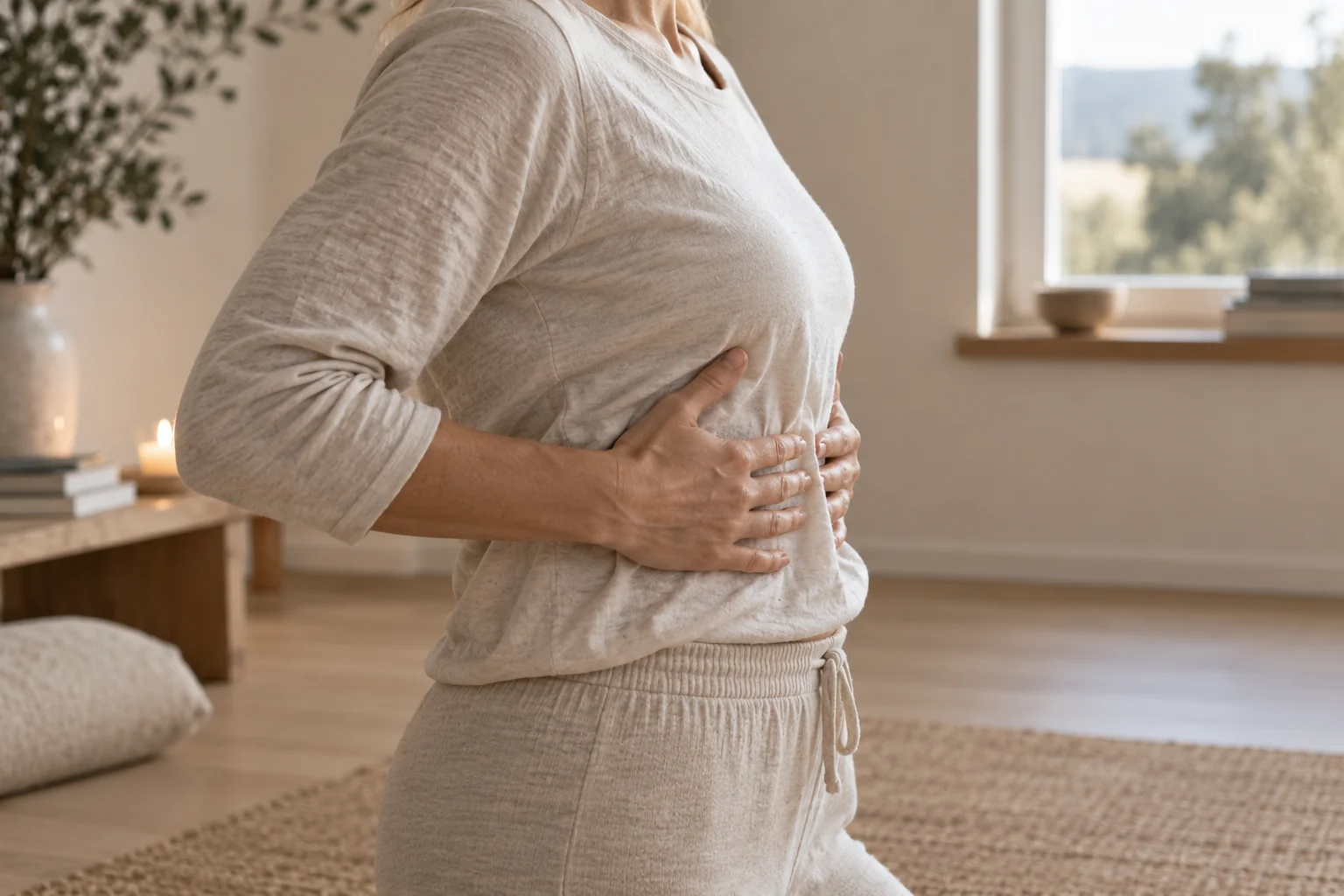
You breathe out fully, then hold, and create a gentle vacuum in the belly by drawing everything up and in. It looks distinctly odd the first time you try it. But that vacuum does something clever: it reflexively switches on the deep core and the pelvic floor, without you consciously squeezing anything.
That is the key difference from a standard pelvic floor exercise. A Kegel asks you to clench. A hypopressive asks the body to respond on its own, the way it is designed to.
Where biomechanics comes in
Here is the bit most classes skip. Your pelvic floor does not work in isolation. It is part of a pressure system that includes the diaphragm, the deep abdominals and the glutes, among others.
If your posture is off, if you are gripping through the ribs, or if your alignment is pulling everything out of sync, your pelvic floor is working uphill no matter how many exercises you throw at it.
This is where biomechanics changes the outcome. Rather than teaching the breath-and-vacuum technique on its own, we look at how you stand, how you carry your ribcage over your pelvis, how you breathe day to day, and how your body manages everyday pressure: coughing, lifting a child, sneezing, running for a bus. We work on the framework the pelvic floor operates inside, not only the pelvic floor itself.
"You are not just training a muscle. You are retraining the whole system that muscle depends on, which is why it holds up in daily life and not only in a class."
Why this matters particularly for women
Pregnancy, birth, hormonal change and, frankly, years of sitting at a desk all change how the pressure system behaves. Many women are told to do their pelvic floor exercises and left to work out the rest on their own.
If your ribs are flared, your posture has collapsed, or you are holding tension somewhere apparently unrelated, a clench in isolation will not address that. Combining hypopressive breathing with a proper biomechanical assessment means we are not guessing. We look at your actual movement patterns and work out where the difficulty really sits, whether that is core function, posture, breathing mechanics, or how you load your body across a day. Then the plan is built around you rather than off a shelf.
Two practical notes. If you are pregnant, hypopressives are generally not the right thing, because the technique involves breath holds and abdominal vacuums, so wait until after birth and get individual guidance first. And if you are experiencing pain, leaking or a sensation of heaviness, a pelvic health physiotherapist is a sensible first port of call. Your GP can refer you, and it is free.
The honest bit
This is not a quick approach and it is not magic. It takes practice, and there will be days when your body does not cooperate, which is completely normal.
But when hypopressives and biomechanics work together, you are not simply exercising a muscle in isolation. You are retraining the whole system that muscle depends on. That is why the result carries over into ordinary life rather than living only inside a class.
If pelvic floor advice has always felt too vague to actually help, that gap is usually the reason, and it is what a proper biomechanical look at you is for.
Welvow includes biomechanics coaches, pelvic health physiotherapists, Pilates teachers and postnatal specialists working with posture, core function and pelvic floor. If you have symptoms rather than simply questions, start with a pelvic health physiotherapist. Your GP can refer you on the NHS, and many practitioners also see people privately and online.
Find your practitionerMost of the frustration people feel with pelvic floor advice comes from being handed one exercise and no context. The exercise is rarely the problem. The context almost always is.