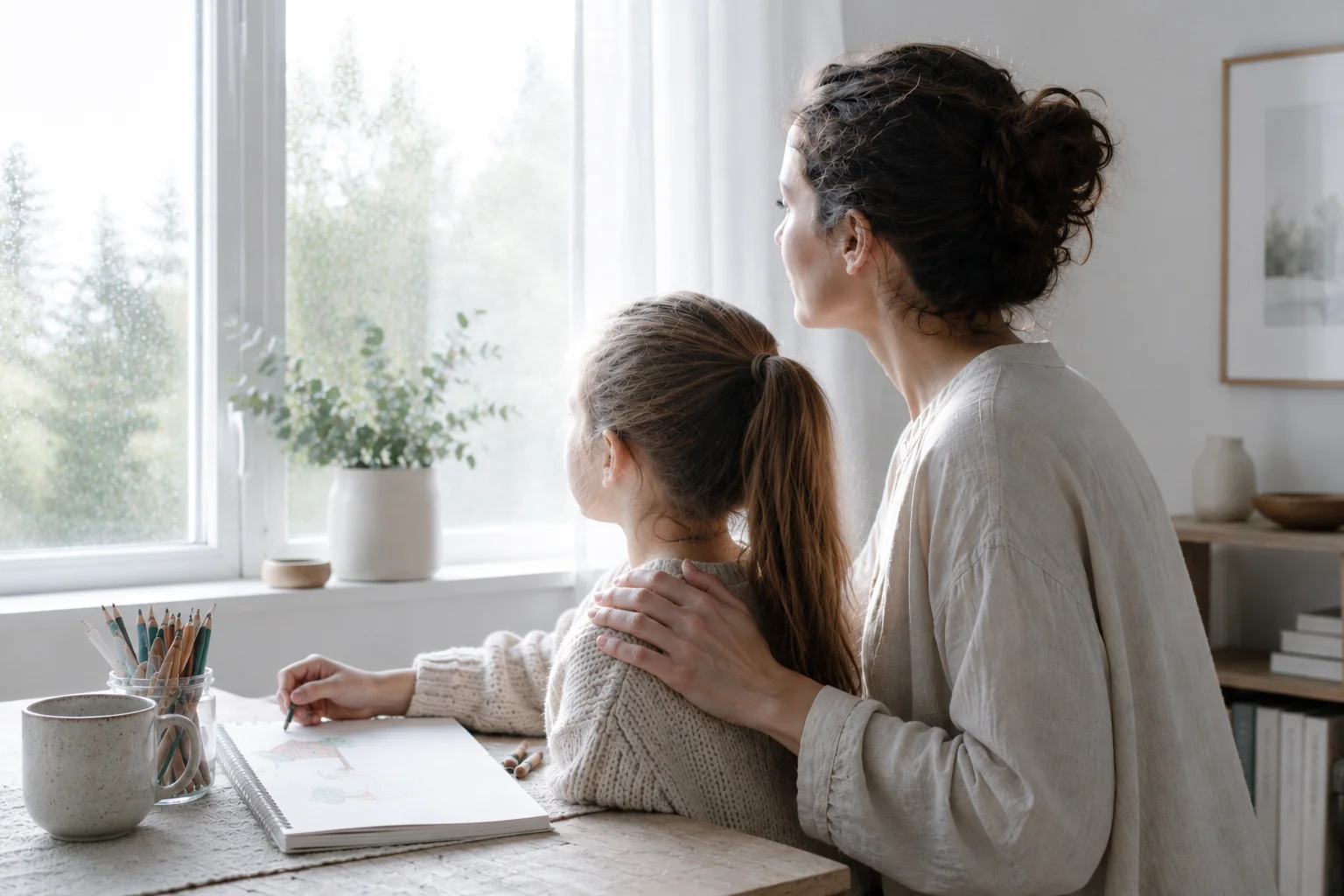
Anxiety among children and young people is rising, and most parents have noticed it in some form. The sudden tummy aches before school. The worry about sleeping alone. The reluctance to do things that used to feel ordinary, playing in a friend's garden, eating in a busy place, going on a school trip.
What if anxiety isn't the enemy here, but a message? A quiet signal from the part of the mind that's trying its hardest to keep a child safe.
The subconscious as a quiet protector
The subconscious mind is the part of us that learns from experience and repetition rather than logic. It listens to the tone of voices, the rhythm of days, the patterns of what feels safe and what doesn't. Children don't have the filters adults do, so their subconscious takes in everything, our pace, our worries, the news playing in the background, the speed of the screens around them.
When a child's day feels predictable, warm and connected, their subconscious learns that the world is broadly manageable. When life feels rushed, uncertain or full of comparison, that same protective part begins to think, "Better stay on guard." Anxiety, in that frame, isn't a flaw, it's a child whose internal safety system has become a little over-tuned.
Why so many children feel on edge
Childhood has changed quietly but considerably in a single generation. A few threads seem to be at work.
Devices and disconnection
More of childhood now happens through screens. Online, things move faster, and the small moments that build confidence, the eye contact, the pauses, the repair after a small disagreement, happen less. Without those, the subconscious misses some of its most important lessons in social safety.
Less unstructured play
When play was freer, children learned how to wobble and recover. Climbing too high and coming back down. Sorting out small arguments with friends. Today, much of play is supervised or scheduled, which means fewer natural opportunities for the subconscious to practise its recovery muscle.
Over-protection, kindly meant
Modern parenting is full of love, and also a lot of worry. In wanting to keep children safe from every wobble, we can accidentally teach them that discomfort is something to be avoided rather than moved through. A child who never gets to feel a little nervous and succeed anyway misses the experience that tells the subconscious, "I can handle this."
What quietly helps
The aim isn't a worry-free childhood. The aim is a child whose subconscious has gathered enough small, repeated evidence that the world is largely safe and that they can recover from the moments when it isn't.
Simple, predictable routines
Calm mornings, unhurried meals, gentle bedtimes, these quietly tell the subconscious, "Life is steady; you can exhale." Routine doesn't need to be rigid. It's the rhythm that matters.
Small acts of bravery
Confidence grows in tiny doses. Letting a child order their own food in a cafe, ask a question, try something new on their own. Every time they take a small risk and come through it, the subconscious records, "I can do hard things."
Stay nearby, don't rush in
When a child struggles with something, the temptation is to step in and smooth it. Staying nearby while they ride the wave and find their own way back is often more useful. That moment of recovery is where resilience is gently built.
Keep connection at the heart
A calm voice, a quiet hug at the end of the day, a few minutes of attention with no agenda, these say more to the subconscious than any lecture about being brave. Children need to feel seen, especially when the world finally slows down enough for the worries to come up.
How hypnotherapy fits in
Cognitive Behavioural Hypnotherapy is one approach that brings the body and the subconscious together. In a gentle, relaxed state, children can rehearse confidence in their imagination, walking calmly into school, taking a penalty shot, sleeping in their own bed. The mind doesn't sharply distinguish between imagined and real experience, so each rehearsal quietly gathers as evidence that they can.
Beneath every anxious behaviour is a child quietly saying, "I just want to feel safe."
If your child is struggling with anxiety and you'd like to explore some support, a hypnotherapist trained in working with children, a play therapist or a child counsellor can all be gentle starting points. Welvow's directory includes practitioners who work with families navigating childhood worry, school anxiety and the everyday wobbles that come with growing up.
Find your practitionerAnxiety isn't a flaw, it's a message. When children gather enough small, steady evidence that the world is safe enough and that they can recover from the moments when it isn't, the worry usually softens on its own.