I spent twenty-seven years as a nurse, and most of that time I was watching nervous systems respond to stress: in the people I looked after, in my colleagues, and eventually in myself.
What I came to think is that a great deal of what we label anxiety or overwhelm is something more specific than a mood. It is a nervous system stuck in a gear it cannot get out of.
Two settings, and getting stuck in one
The autonomic nervous system runs, broadly, on two settings.
The sympathetic branch is the one everybody has heard of, the fight or flight setting. Cortisol and adrenaline rise, the heart speeds up, attention narrows onto whatever might be a threat. It is not a fault. It is a survival system and it works beautifully.
The parasympathetic branch is the counterweight: rest and digest. Heart rate settles, digestion picks up again, muscles let go, and there is finally room in your head to think.
The trouble is that a lot of people spend far too much of their lives in the first setting. Racing thoughts. Shallow breathing that never quite reaches the bottom of the ribs. Shoulders somewhere around the ears. A mind that will not slow down even when nothing is actually wrong. For anyone living with anxiety, the difficulty is often less about the threat and more that the system has lost the knack of coming back down.
Where Reiki comes in
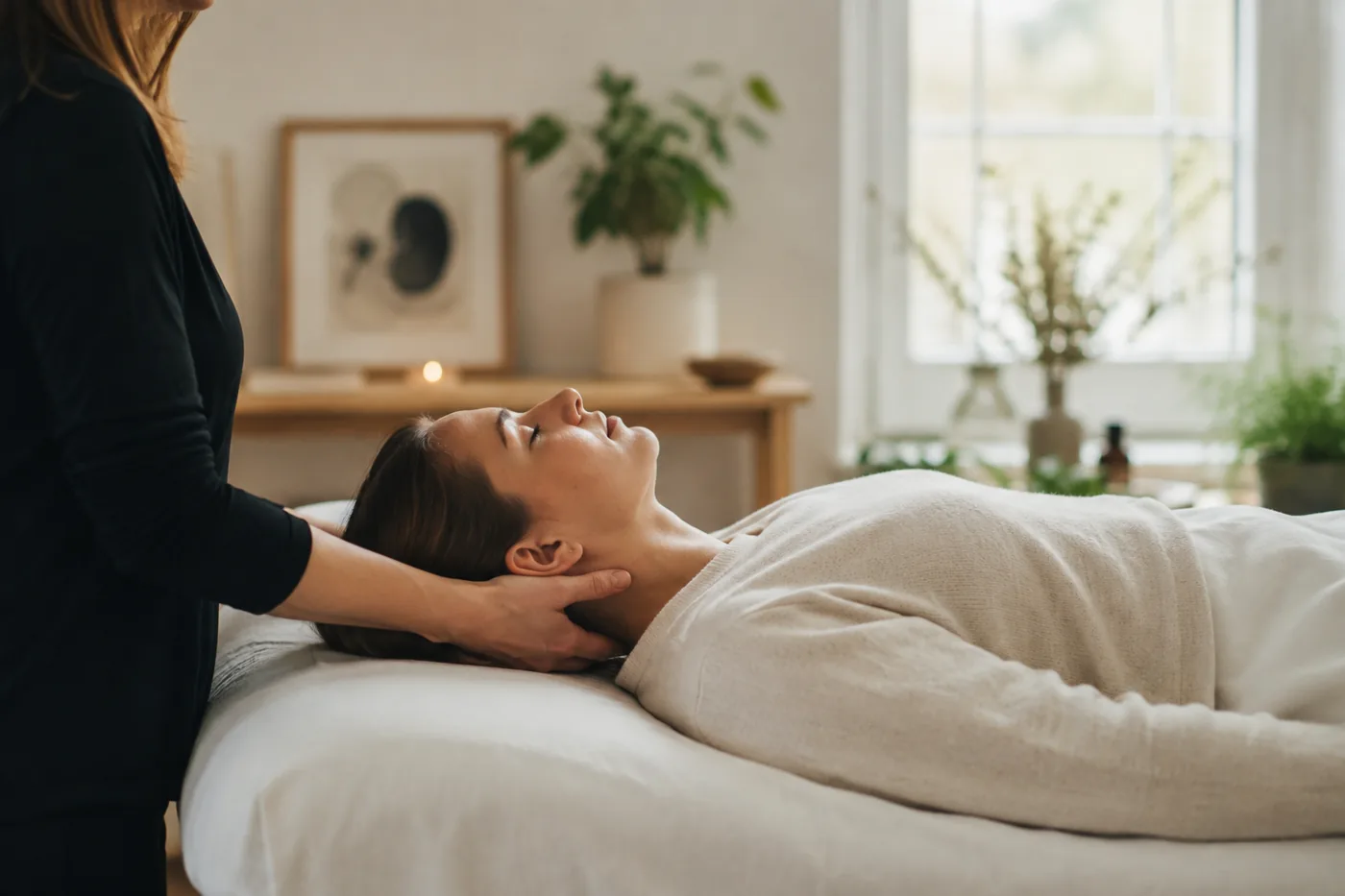
Reiki is a gentle Japanese practice. The practitioner rests their hands lightly on the body, or holds them just above it if you would rather not be touched, and works through a sequence of positions. You stay fully clothed. You do not have to do anything.
What most people notice is the stillness. Nothing is being asked of you for the length of the session, and the pace is unhurried in a way that ordinary life almost never is. Many describe it as an invitation to the body to come out of high alert.
In my own room I watch people arrive carrying tension they are not consciously aware of. Within a few minutes the breathing lengthens, the shoulders come down, and the whole body seems to soften. For someone with anxiety, that shift can feel like exhaling after holding your breath for hours. As the body settles, the racing thoughts often quieten too. Not because anything has been solved, but because there is finally space to think.
"Giving a nervous system regular opportunities to come back down is not indulgent. For a lot of people it is the thing that has been missing."
Being straight about the evidence
I want to be clear about what is and is not established, because I think people deserve that before they book anything.
The nervous system science is solid and well understood. What is far less settled is Reiki specifically. The studies that exist tend to be small, and it is genuinely difficult to separate the effect of the practice itself from the effect of lying still in a quiet room for an hour with someone's full attention on you.
My own view, after a career in healthcare, is that the second thing is not nothing. But I would not want anyone booking on the basis that the evidence is stronger than it is. Reiki is a complementary practice. It sits alongside good care. It does not replace therapy, medication or a conversation with your GP where those are what is needed.
If you are thinking about trying it
- Sessions usually run 45 to 60 minutes. You stay clothed and you can ask for hands-off throughout.
- Say at the start if you would rather not be touched, or if there are areas to avoid. A good practitioner will ask anyway.
- Reiki is not statutorily regulated in the UK, so ask what training your practitioner has done and how long they have been working.
- Some people feel deeply relaxed and a little floaty afterwards. Some feel very little the first time. Both are ordinary.
- If anxiety is significantly affecting your daily life, please speak to your GP alongside anything else you try.
Welvow includes Reiki practitioners alongside breathwork teachers, counsellors and others working with anxiety and nervous system regulation including Jin Sidhu. Most offer a short introductory call, which is the easiest way to ask what a session involves before committing to one.
Find your practitionerIn a world that keeps so many of us running in the first gear, giving the nervous system chances to shift into the second one is not a luxury. Reiki is one gentle route to that. It is not the only one, and it will not suit everybody. But for people who have tried thinking their way to calm and found it does not work, starting with the body rather than the mind is often the more useful direction.