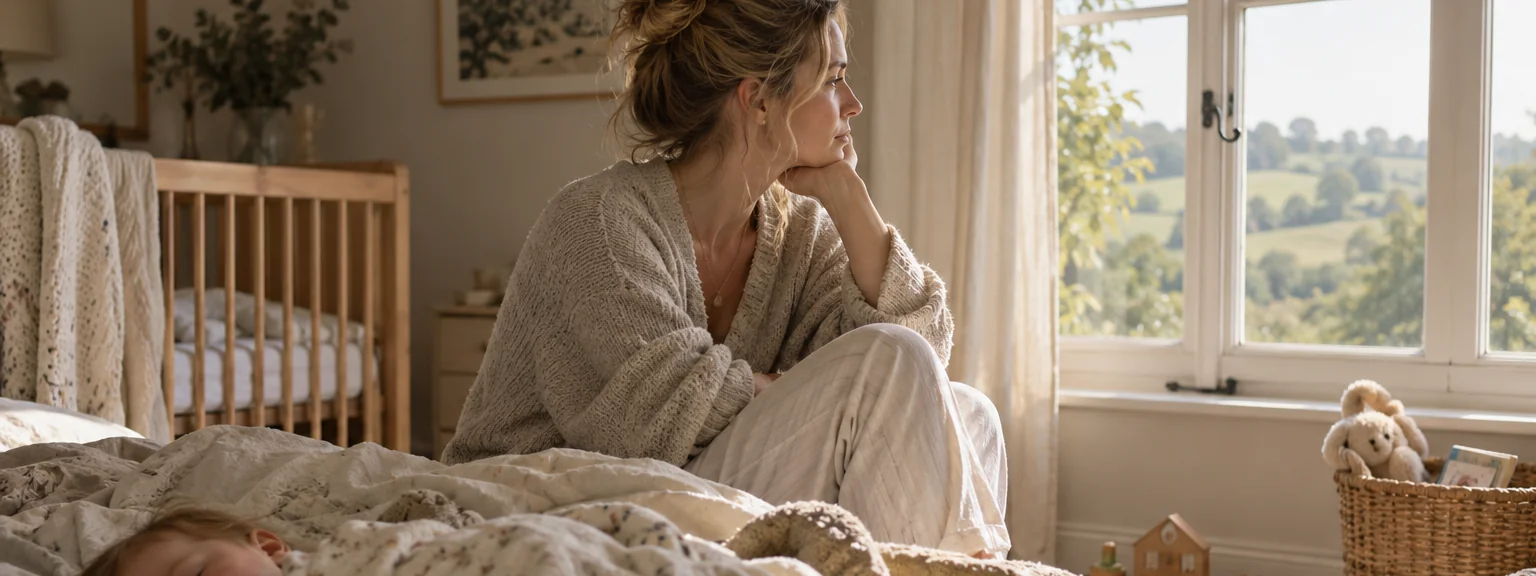
Having a baby is supposed to be one of the happiest times of your life. Mothers-to-be are led to expect that they will feel fulfilled, grateful and contented in the new role. And those feelings usually are part of it. They are simply not all of it.
Alongside the emotions everybody prepared you for, many women — possibly all women — also meet uncertainty, fear, loss, anger, overwhelm and guilt, along with a sense of having mislaid themselves somewhere along the way. It is a shock when those arrive uninvited, and no surprise at all that so many women conclude something must be wrong with them.
There is a word for this
Perinatal mental health difficulties are real and worth taking seriously. But intense anger, grief, overwhelm, sadness, regret, resentment, fear or plain boredom can also be signs of something far more ordinary, and far more universal.
Matrescence is a term coined by the anthropologist Dana Raphael in the 1970s. It describes the psychological, emotional, physical and social transition of becoming a mother. Like adolescence — and the echo in the word is deliberate — this becoming takes time. A great deal of time. It asks for energy, effort and a tolerance for frustration and false starts. It is often painful and frequently disappointing. It reshapes identity and relationships, as well as the body and the brain. It begins before pregnancy and carries on for months or years after birth.
Becoming a mother is not a switch that flips from off to on. It is nothing like that.
Gains and losses, held at the same time
Matrescence raises questions about the essence of who you are — or rather, who you are now. It can bring enormous gains while simultaneously involving losses that are hard to name and harder to measure: of freedom, of the body you had lived in until now, of confidence, of status, of particular friendships.
It makes you wonder what matters most, what kind of parent you want to be and what kind you are actually going to be, what you hope to pass on and what you would rather protect your child from. Contradictory feelings surface constantly and confoundingly. Ambivalence is a completely normal part of the picture, though it is rarely spoken about.
That cauldron is difficult to make sense of at the best of times. It is harder still when the culture around you insists motherhood should feel joyous, fulfilling and natural — with the unspoken corollary that if it does not, you are failing.
"You do not have to choose between loving your baby and wanting an hour away from him. Both can be true in the same afternoon, and usually are."
Why "bouncing back" was never the point
Every life transition brings change and disruption. Old routines disappear. Relationships shift. Parts of a previous identity become harder to reach or express, while new capabilities, new values and new ways of belonging start to form.
Seeing matrescence as a developmental transition rather than a problem to be solved takes some of the pressure off — the pressure to bounce back physically, and the quieter pressure to bounce back emotionally. It makes room for a gentler adjustment.
And like adolescence, it is nowhere near linear. Weaning, moving your baby into their own room, going back to work, a first birthday, the first day at nursery — each can land as another small transition, each capable of raising fresh questions about what you value and who you are becoming.
What seems to protect us
The Social Identity Model of Identity Change, set out by Catherine Haslam and colleagues, suggests that wellbeing through major life change is protected largely by keeping and building meaningful social identities.
In practice that means three things: going into a transition with more than one meaningful identity rather than just the one; holding on to valued groups and roles from before while developing new ones; and, where possible, keeping old and new identities compatible with each other rather than in competition.
Put more simply, transitions unsettle us less when we do not lose our sense of belonging. That may sound obvious. It is worth saying anyway, because the sentence I hear most often from new mothers is: I just don't know who I am any more.
Importantly, this is not the usual instruction to get more social support. The argument is subtler — what matters is belonging to groups that become a valued part of how you see yourself, because those are the identities that carry meaning, support and a sense of agency through a period of change.
Four things that tend to help
There are as many versions of this transition as there are mothers, and naming matrescence is partly about giving that complexity somewhere to live. There is no inoculation against the upheaval, but a few principles are worth holding on to.
- Make room for the whole experience. Mixed feelings are normal. Gratitude and resentment are not mutually exclusive, and you are not required to pick one.
- Stay connected. Relationships, communities and roles offer practical help, but more than that they offer belonging and perspective.
- Attend to your own needs. Food, movement, rest, time alone and something meaningful to do are not luxuries. They are what wellbeing is built from.
- Practise self-compassion. Adjusting takes time and patience, and comparing yourself unfavourably with other mothers is almost never useful.
If what you are carrying feels heavier than this — if it is not lifting, or it frightens you — that is worth saying out loud to your GP, midwife or health visitor. Not because you have failed the transition, but because some things deserve more support than a set of principles can offer.
Welvow includes counsellors, psychotherapists, perinatal specialists and birth and postnatal doulas who work with women through pregnancy and early motherhood. Many offer a free introductory call and see people online, which can matter a great deal when leaving the house is the hardest part of the day.
Find your practitionerNobody warns you that becoming a mother involves becoming somebody slightly different, and that the somebody arrives gradually rather than in the delivery room. Knowing the transition has a name does not shorten it. It does make it a good deal less lonely.