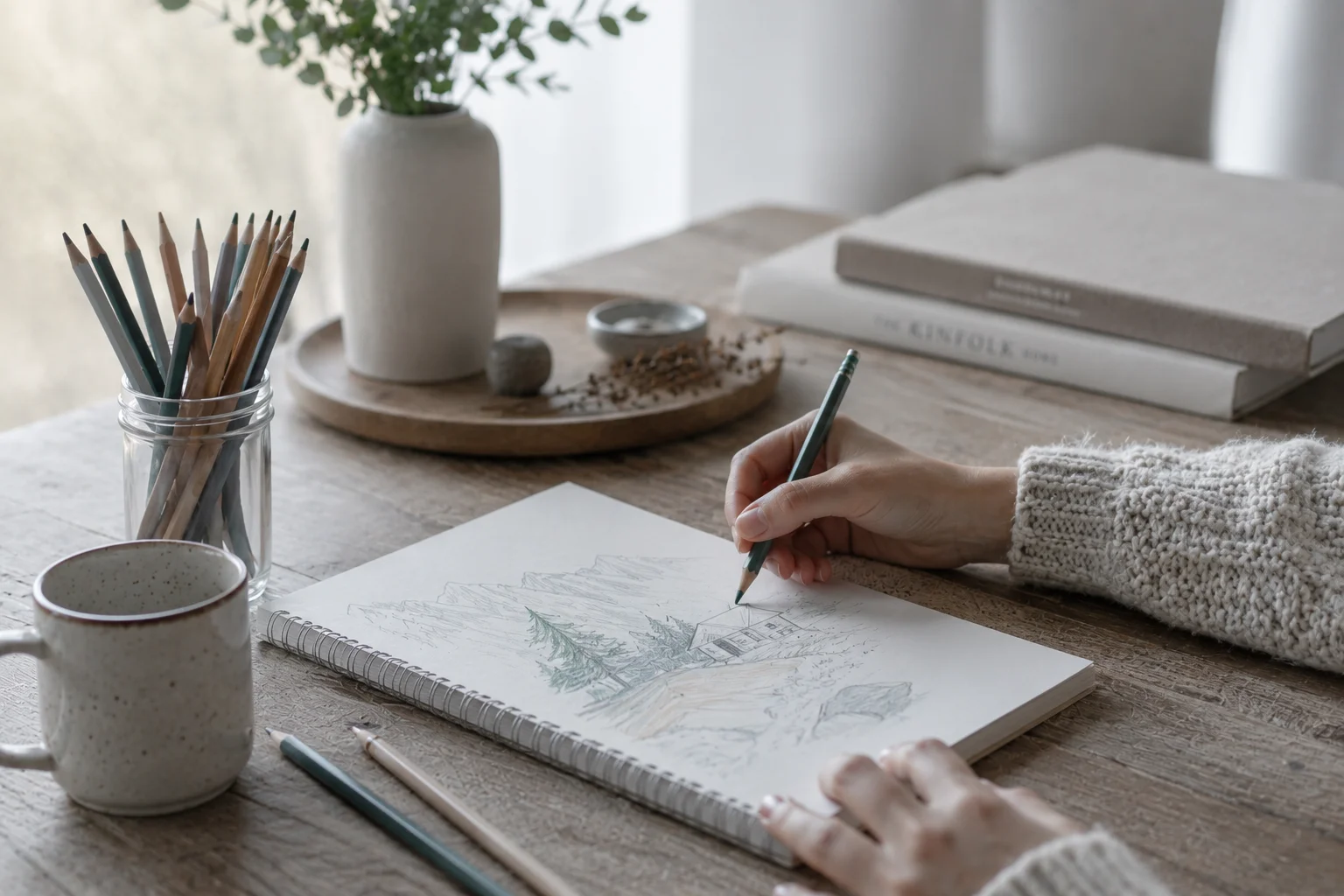
Some things are too big for words alone. Children, in particular, often don't have the language for what they're carrying, but most adults will recognise the feeling too. There are moments when sitting opposite someone and being asked, "Tell me how you feel," is the last thing the nervous system can find an answer to.
Drawing and Talking therapy was developed in the early 2000s as a gentler, less confronting alternative to talk-focused therapies. It's now used in mental health services and schools across the UK, and it works in a way that's quietly different to what many people expect.
How a session unfolds
Sessions are short, usually thirty minutes, and run for twelve weeks. The format is simple: the person draws something, anything they like, and we talk about the picture. The conversation is led by them, not by the practitioner. Drawing skills don't matter; the picture is a tool, not an artwork.
What looks deceptively simple on the surface is doing something quite particular. The drawing gives the mind something to look at while the harder feelings move underneath. The conversation stays gentle, exploratory, and never directly aimed at the difficult thing. Over the weeks, as trust grows, the pictures often begin to change, and so do the conversations around them.
Who it can support
People come to Drawing and Talking for many reasons. Some that come up often:
- Stress and worry that doesn't seem to have a single cause
- Phobias and fears
- Low confidence or feeling withdrawn
- Bereavement or loss
- Navigating parents separating
- Difficulty connecting with others or with friendships
- Big changes in the family
- Sleep that has become unsettled
- Processing experiences around illness or disability
The work has been done with children as young as six, with teenagers, and with adults, the format flexes more than people expect.
Why it isn't about analysing the drawings
A common worry is that the practitioner will "interpret" what the picture means. They won't. The pictures are not analysed and there's no hidden meaning being decoded. They're simply a way for the person to put something on paper that's been quietly pressing inside, and to have a calm, attentive presence sit with them while they do.
What many parents notice over twelve weeks is something subtle but real. A child seems a little calmer in themselves. They open up more easily at home. A weight that had been there seems to have eased. They all describe enjoying having a space that's entirely theirs, no agenda, no marks, no questions to answer.
"The drawing gives the mind something to look at while the harder feelings move underneath."
If something here resonates, a Drawing and Talking practitioner can be a gentle starting point, particularly for children or young people who find direct conversation difficult, or for adults who'd prefer a less verbal way of processing. Welvow's directory includes practitioners who offer Drawing and Talking therapy alongside other creative and expressive approaches.
Find your practitionerThere are many ways into the same room. For some, that door is talking; for others, it's drawing, moving, writing or simply being heard. Wherever a person begins, the gentle work of being met where they are is always enough.